Bra Gore Not Lying Flat?
If this is what your bra is doing, you are in the right place. It is a fit problem, not a you problem.
5 Causes & How to Fix Each One
The center gore (the panel between the cups) should tack flat against your breastbone. If it floats off your chest, the fit is off. Here is why it happens and how to fix it.
Last updated: August 2026 · 5 causes covered · Diagnosis + fix for each

See what actually fits you
Tell us your size and we will match bras from our catalog to it, translated to each brand's own sizing.
Private and free, no account needed. And if your size might have changed lately - bodies do that - the chat can re-check it in about two minutes.
Quick Diagnosis Checklist
Run through this to narrow down the most likely cause. Check every statement that applies:
The gore sits a finger's width or more off my chest
Likely cause: Cup too small
The cups feel fine but the gore still won't tack
Likely cause: Wrong cup shape or wire width
I have full or close-set breasts
Likely cause: Close-set tissue
The band rides up and the gore lifts with it
Likely cause: Band too loose
My breasts spill over the top or sides
Likely cause: Cup too small
5 Reasons Your Gore Won't Lie Flat (And How to Fix Each One)
Cup Too Small
This is by far the most common reason. When the cups can't hold all your breast tissue, the tissue pushes the wires and the center gore forward, so the gore floats off your sternum instead of tacking against it. If your gore doesn't lie flat, check cup size first.
How to Diagnose
- Look in a mirror from the side: is the gore sitting a finger's width or more off your breastbone?
- Check for spillage over the top, sides, or under the arm, a classic sign the cup is too small
- See whether the wires are sitting on breast tissue instead of flat against your ribcage
- Do the lean-forward test: lean forward, settle into the cups, stand up. If tissue is squeezed out, size up
The Fix
Go up one cup size, keeping the same band. If you wear 34D and the gore floats, try 34DD. Many people need to go up two or more cups, because the 'too small' habit is deeply ingrained. A correctly sized cup lets the gore drop flat against your chest.
Pro tip: Cup volume changes with the band too. If you also size the band down, go up an extra cup letter to keep the volume (sister sizing).
Wrong Wire Width or Cup Shape
Even in the right size, a wire that is too wide or too narrow for your root (the base of your breast) won't sit in the crease, so the gore can't tack. A cup shape that doesn't match yours, for example a shallow cup on projected tissue, does the same thing.
How to Diagnose
- Check whether the wires sit inside your inframammary fold (the crease under the breast) or on top of tissue
- See if the wire extends too far toward your armpit or pinches at the sides
- Note whether the same size tacks fine in one brand but floats in another (a shape or wire-width mismatch)
- Look at whether the cup gapes at the top (too projected) or digs (too shallow) for your shape
The Fix
Switch brands or cup styles rather than sizes. Projected shapes do better in seamed, deeper cups (Panache, Freya, Fantasie); shallow shapes suit molded or demi cups. If a wire is too wide and pokes toward your armpit, a brand with a narrower wire and a different cup shape will let the gore settle.
Pro tip: Read our breast shape guide to match cup shape to your shape, which fixes gore float that sizing alone can't.
Close-Set Breasts
If your breasts sit close together with little space between them, a standard gore has nowhere to tack, because your tissue occupies the space the gore needs. This is a natural shape, not a fitting mistake, and it needs a specific style rather than a size change.
How to Diagnose
- Look at how much flat space sits between your breasts, close-set means very little
- Notice if the gore rests on breast tissue rather than skin
- Check whether a plunge or lower gore sits better than a full cup
- See if the gore tacks when you gently separate the breasts by hand (confirms close-set is the issue)
The Fix
Choose a plunge or a bra with a low, narrow gore, which needs less flat chest space to sit against. Full, tall gores fight close-set tissue; a plunge gore drops between the breasts more comfortably. Accept that a perfectly flat tack may not happen with a full cup, and that is fine if the support is right.
Pro tip: A plunge bra with a low center is the go-to style for close-set breasts.
Band Too Loose
The band anchors the whole bra. If it's too loose it rides up, and as the back rises, the front and the gore lift away from your chest. A gore that floats along with a riding-up band is usually a band problem, not a cup problem.
How to Diagnose
- Pull the band away from your back: if it stretches more than two inches, it's too loose
- Check which hook you're on. If you're already on the tightest hook, the band is too big
- Look at whether the back band is higher than the front (a riding-up band lifts the gore)
- Notice if the gore tacks when you hold the band down firmly (confirms the band is the cause)
The Fix
Go down a band size and up a cup letter to keep the volume: 36D becomes 34DD. A firm, level band holds the front of the bra, including the gore, against your body. Always buy a new band snug on the loosest hook so it stays firm as the elastic relaxes.
Pro tip: The band should be level all the way around and snug on the loosest hook when new.
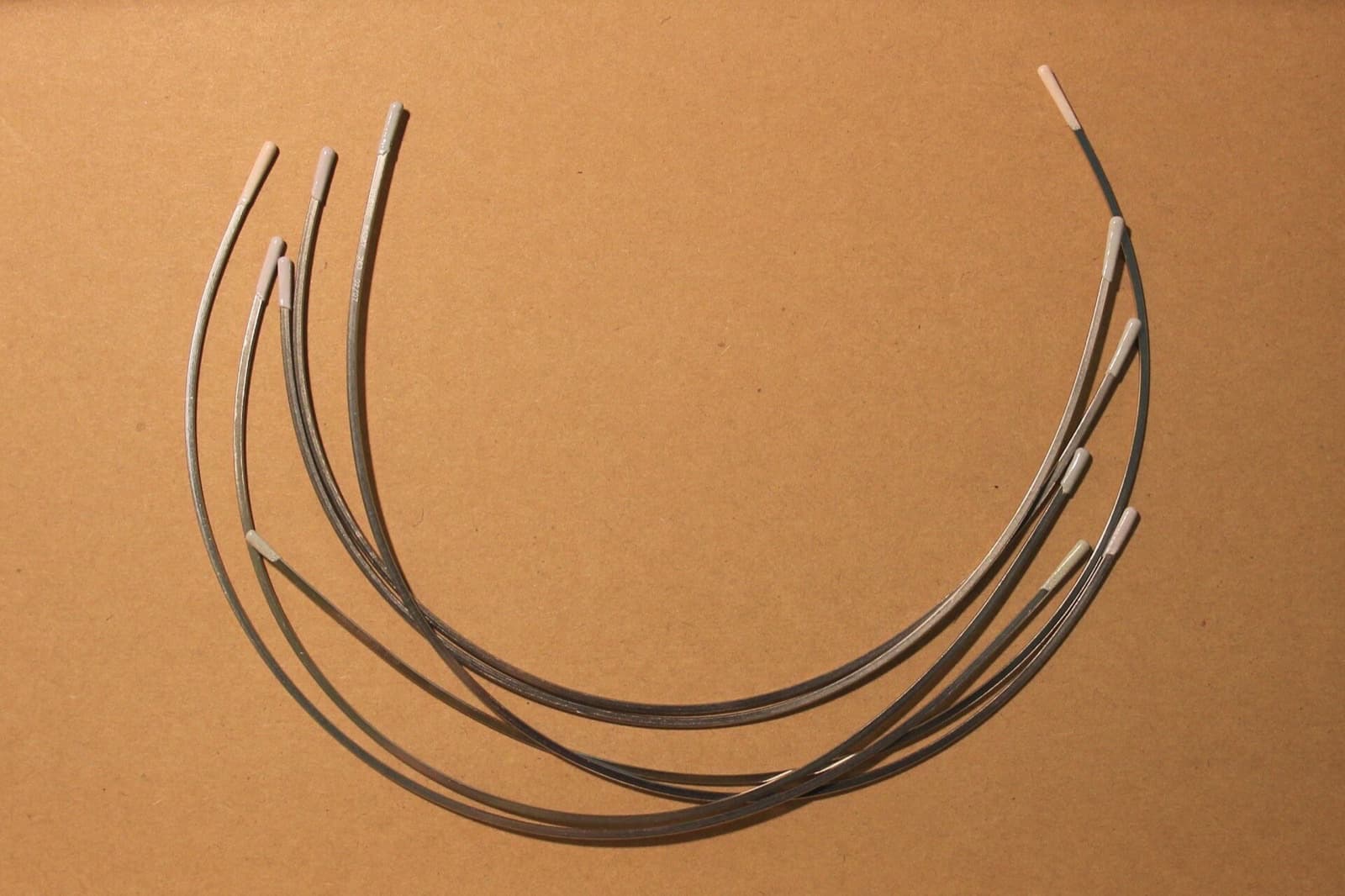
Worn-Out or Warped Wire
An old bra can have a warped or splayed underwire that no longer follows your body's shape, so the gore lifts. Washing, heat, and time all bend wires out of their original curve, and once they're warped the gore can't tack no matter the size.
How to Diagnose
- Lay the bra flat and look at the wires: are they splayed outward or bent out of shape?
- Check if the bra is more than 9-12 months old with regular wear
- Feel for a wire poking through the fabric or sitting at an odd angle
- See if a newer bra in the same size tacks fine (confirms the old one is warped)
The Fix
Replace the bra. A warped wire can't be reliably reshaped at home, and a bra past 9-12 months of regular wear has usually lost band elasticity too. To make the next one last: hand wash or use a lingerie bag, never tumble dry, and rotate between at least three bras.
Pro tip: Rotate three or more bras and never machine-dry them to keep wires from warping early.
How to Prevent It
Get the cup right first
Most gore-float is a too-small cup. Size up until the gore drops flat and there is no spillage, then fine-tune the band.
Match cup shape to your shape
Projected shapes need deeper seamed cups; shallow shapes need molded or demi cups. The right shape lets the gore tack.
Keep the band firm
A snug, level band on the loosest hook holds the gore against your chest. Replace the band when it stretches out.
Try a plunge if close-set
Close-set breasts do best with a low, narrow gore. Don't force a full, tall gore to tack when a plunge fits better.
Frequently Asked Questions
Should the center of my bra lie flat against my chest?
Yes. The center gore (the panel between the cups) should tack flat against your breastbone in a well-fitting underwire bra, for most breast shapes. If it floats off your chest by a finger's width or more, the fit is off, most often because the cup is too small. Close-set breasts are the exception, where a full gore may never fully tack and a plunge fits better.
Why won't my bra gore tack even in the right size?
If sizing is correct and the gore still floats, it is usually a shape or wire-width mismatch: a wire too wide for your root, or a cup shape that doesn't match your tissue. Try a different brand or cup style, deeper seamed cups for projected shapes, molded for shallow. Close-set breasts may also prevent a full gore from tacking, so a plunge helps.
Does a floating gore mean my cup is too small?
Most of the time, yes. A too-small cup pushes the wires and gore forward off your chest. Check for spillage and whether the wires sit on tissue rather than your ribcage, then size the cup up. If sizing is right and it still floats, look at cup shape, wire width, band tightness, or a close-set shape.
Is a plunge bra better for close-set breasts?
Yes. Close-set breasts leave little flat space for a tall, full gore, so a plunge with a low, narrow center sits more comfortably between the breasts. If your gore rests on tissue rather than skin, you likely have a close-set shape and a plunge is the better style.
Can a bra gore lie flat with large breasts?
Yes, in a correctly fitted full-bust bra it should. Large breasts often float the gore simply because the cup is too small, a very common issue when mainstream cups stop at a DDD. In a properly sized G+ cup from a full-bust brand, the gore tacks flat just as it should at any size.
Related Guides
Why Does My Bra Ride Up? Causes & Fixes
7 reasons your bra rides up in back and how to fix each one. Quick diagnosis guide included.
Best Bras When Your Band Rides Up
A band that rides up is almost always too big. How to fix it by sizing down, plus firm-band bras that sit level all day.
Bra Straps Digging In? Here's Why & How to Fix It
6 reasons your bra straps dig in and how to fix each one. Plus product recommendations for wide-strap bras.
Will a Wireless Bra Actually Support Me?
Wireless can genuinely support, including larger cups - but most fail for 5 fixable reasons. Diagnose why yours don't hold and what construction to buy instead.
Full-cup bras that help the gore sit flat
Browse all brandsIn-stock full-coverage bras across cup sizes, where a correctly sized cup lets the gore tack.

Panache
Serene Full Cup Bra - Noir

Freya
Quinn Molded Spacer Bra: Cameo

Fantasie
Envisage Full Cup Side Support Bra: Natural Beige

Elomi
Smooth Molded Bra: Deep Emerald
Prices and availability update as our catalog refreshes.
Get the Gore to Tack
Take our 2-minute quiz to find a size, shape, and style where the center sits flat and the support is right.